
MASW Survey
What is The Multi Channel Analysis of Surface Waves (MASW)
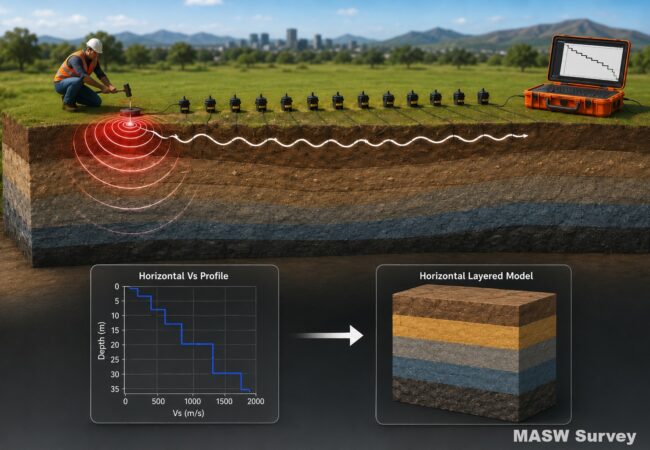
The Multichannel Analysis of Surface Waves (MASW Survey) technique is a non-invasive seismic approach that exploits the elastic properties of subsurface materials to detect subsurface structures. By examining the dispersion properties of different frequencies emitted by a single seismic source, it is possible to derive shear wave velocities (Vs) and related geotechnical parameters.
MASW uses an active seismic source, which can be a hammer, a rapid weight-loss impactor, or an airgun (which uses compressed air or nitrogen for marine projects) to generate seismic energy that is primarily composed of pressure (P) waves and shear (S) waves. The method exploits the dispersive nature of a specific wave that contains both P- and S-wave components, known as a surface wave (Rayleigh waves on land and Scholte waves in water). It provides valuable information about the shear wave velocity at a depth determined by the frequency range of the energy source and the array configuration.
Seismic surface waves have dispersion properties that are not present in conventional body waves. Different wavelengths penetrate to different depths, resulting in different phase velocities, where an increase in wavelength is proportional to an increase in penetration depth. Since surface waves are the dominant waves generated by any seismic source, the quality of MASW data (signal-to-noise ratio) is generally better than that of other seismic methods, such as seismic reflection or refraction.
MASW Survey
How MASW Survey Is Preformed
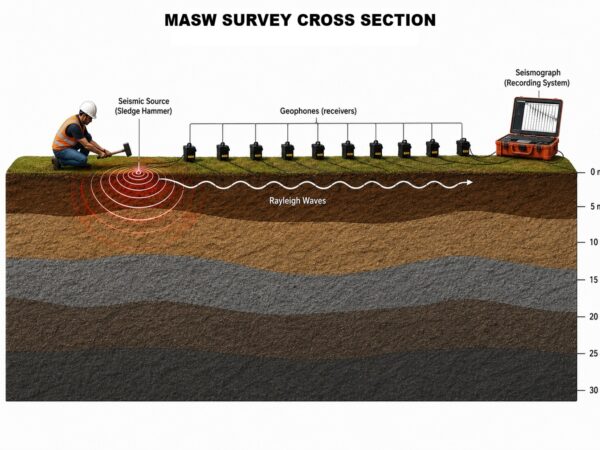
A geophone array is used to capture the propagation of surface waves. These waves can be generated by active or passive sources. Examples of active sources include impact hammers and weight loss from vehicles. On the other hand, passive sources include ambient noise, including traffic or construction sounds. A model of the shear wave velocity can be derived from the dispersion spectra calculated from the recorded seismic surface waves. This model subsequently helps to determine the maximum shear modulus or ground stiffness of the subsurface material.
Surface wave survey serves as a flexible tool that is applicable to a variety of uses. Common applications include:
• Identification of voids and/or insufficiently stable soil properties.
• Estimation of bedrock depth.
• Investigation of geological structures and assessment of landslide potential.
• Monitoring subsurface changes, such as settlement or differential compaction.
• Assessing site conditions for construction projects.
• Production of subsurface seismic velocity profiles.
MASW Survey
Equipment Used For Multi Channel Analysis of Surface Waves (MASW)
Geophones: In MASW surveys, geophones act as the main sensors to detect ground vibrations caused by seismic waves. These sensors are carefully placed on the surface of the earth to accurately record the signals generated by the waves.
Seismic source: A seismic source, usually a hammer or a vibrating device, is responsible for generating the surface waves required for a MASW survey. The choice of seismic source depends on the specific objectives of the survey and the geological conditions at the site.
Data Acquisition Systems: Advanced data acquisition systems are used to capture and analyze signals received from geophones. These systems are essential for converting raw data into important subsurface models.
MASW Survey
MASW Method Presents a Variety of Benefits, Including:
Non-destructive: The MASW method is an investigation technique that does not cause damage. It eliminates the need for drilling or trenching.
Cost-effective: Depending on the survey design, the MASW method is generally more economical than intrusive survey techniques.
Versatile: The MASW method can be used for a variety of applications, including mapping bedrock depths and assessing construction site conditions.
Efficient: The MASW method is a relatively rapid investigation technique, depending on the specific requirements.
MASW Survey
Applications of MASW Survey in Engineering
Site Characterization: Understanding what lies beneath the surface is crucial when constructing a building, road, or bridge. MASW surveys provide comprehensive insight into the subsurface, which is crucial for selecting the appropriate foundation type and ensuring the long-term stability of the structure.
Earthquake Risk Assessment: For projects located in earthquake-prone areas, MASW surveys are invaluable. By measuring shear wave velocities, engineers can predict the ground’s response during earthquake events, which helps design buildings that can better withstand earthquakes.
Utility and Infrastructure Mapping: In urban areas where there may be existing infrastructure such as pipes, cables or tunnels, MASW surveys are an effective method for mapping these underground utilities, reducing the chances of damaging existing infrastructure during construction.
MASW Survey Work Process
National Line Survey provide Expert and professional Multi Channel Analysis of Surface Waves (MASW Survey) in the fields of residential, commercial, infrastructure, and industrial areas.
National Line Survey (NLS) are available according to your Multi Channel Analysis of Surface Waves (MASW Survey) services requirements at any time in Jubail, Dammam, Khobar, Riyadh, Makkah, Medinah, Jeddah, Yanbu, Jazan, Tabuk, Neom City, and whole Kingdom Saudi Arabia.
Our company (National Line Survey) collect survey data with accuracy and precision to maintain high quality Multi Channel Analysis of Surface Waves (MASW Survey) services.