
GPR Survey and Utility Mapping
What is The GPR Survey and Utility Mapping
A GPR Survey and Utility Mapping uses high-frequency radar waves to identify and visualize underground structures without creating any obstructions on the surface. The technique works by sending electromagnetic pulses into the ground and recording the signals that return from various objects, including pipelines, concrete, metal, and voids. The time it takes for the signal to return and the strength of the reflection are documented to create a comprehensive visual of underground features. Experts can leverage these images to identify utility lines, investigate soil layers, locate buried objects, and even identify archaeological artifacts.
An accurate understanding of underground utilities, structures, and properties is essential for cost-effective, efficient, and safe planning in data-driven engineering and infrastructure. In this context, ground penetrating radar surveys, commonly referred to as GPR surveys, play a critical role. This advanced, non-invasive geophysical technique is commonly used in environmental studies, utility detection mapping, construction, archaeology, and drone-based surveys to visualize underground features using radar pulses. We use for our GPR Survey work Proceq and GSSI Ground Penetrating Radar (GPR) equipment.
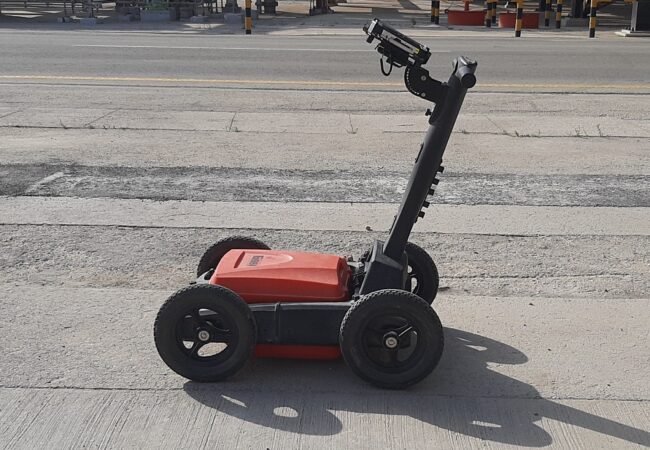
GPR Survey and Utility Mapping
Understanding the Importance of GPR Survey in Multiple Sectors
⇒ In the construction sector, builders conduct underground utility detection survey prior to excavation and foundation activities.
⇒ Infrastructure initiatives such as metro rail systems, airports, highways, and smart city development require comprehensive subsurface mapping.
⇒ In the oil and gas sector, ground penetrating radar (GSSI GPR) is used to locate buried pipelines and underground assets.
⇒ Telecom companies rely on utility detection mapping for their cable installation process.
⇒ Municipal corporations implement GPR inspections for effective drainage and water management systems.
⇒ Railway projects require underground investigations to guarantee safe construction.
GPR Survey and Utility Mapping
Key Applications of Ground Penetrating Radar Surveying
Ground Penetrating Radar (GSSI GPR) surveys are widely used in the Kingdom of Saudi Arabia in a number of sectors, playing a significant role in enhancing safety, efficiency, and accuracy in underground investigations. Key applications of GPR include:
Utility Detection and Mapping: Ground Penetrating Radar (GSSI GPR) is used to locate underground utilities detection such as water pipes, gas lines, telecom cables, and sewage systems. This proactive approach helps prevent damage during construction and excavation activities, reducing project delays and repair costs.
Infrastructure and Road Survey: GPR surveys are essential for assessing road conditions, identifying voids under the pavement, and testing bridge decks. It helps authorities make informed choices regarding maintenance and repairs.
Archaeological Survey: Ground Penetrating Radar (GSSI GPR) is widely used in archaeology to identify hidden structures, ancient artifacts and historical remains without disturbing the site. This technology plays a vital role in protecting India’s rich cultural heritage.
Geological and Environmental Studies: GPR surveys help in detecting variations in soil layers, groundwater levels, bedrock depth, and various geological features. This proves beneficial for environmental impact assessments and site suitability assessments.
GPR Survey and Utility Detection
Archaeological Survey, Geological and Railway and Airport Inspections
Railway and airport inspections: Railways and airports apply GPR technology to detect structural weaknesses, analyze ground surface irregularities, and inspect concrete pavements for unseen defects, which is crucial for maintaining passenger safety and facilitating efficient transportation operations.
Benefits of Ground Penetrating Radar Survey
Accurate Object Detection: GPR surveys provide accurate location information for underground objects, guaranteeing accurate identification.
Non-invasive method: This technique does not require any excavation or excavation, thus minimizing disturbance to the surrounding environment.
Cost-effective: It reduces project costs by accurately identifying the locations of underground objects and preventing unnecessary excavation.
Time-efficient: It offers real-time data, which reduces downtime and allows for quick decision-making.
Versatile: GPR is applied in a variety of fields, including utility detection, concrete inspection, and archaeological surveys.
GPR Survey and Utility Mapping
Choosing the Right GPR Survey Service Provider
When choosing a GPR survey company, consider the following factors:
⇒ Industry experience
⇒ Quality of equipment
⇒ Technical expertise
⇒ Previous project portfolio
⇒ Reporting capabilities
⇒ Turnaround time
GPR survey is a key tool for conducting safe and effective underground investigations. This technology is crucial in a variety of applications, including underground utility mapping, concrete scanning, geological studies, and infrastructure inspections, making it an essential part of contemporary engineering projects.
As urban development continues to expand, the need for accurate ground penetrating radar survey services will increase significantly. Investing in professional GPR scanning enables organizations to improve safety, reduce risks, and improve project implementation.
For applications in construction, infrastructure, industrial, or utility mapping, GPR technology provides an efficient, reliable, and non-invasive solution for underground investigations.
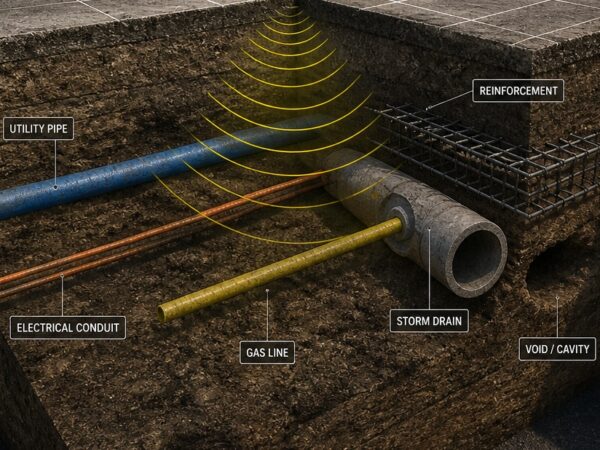
GPR Survey and Utility Mapping Process
National Line Survey provide Expert and professional GPR Survey and Utility Mapping in the fields of residential, commercial, infrastructure, and industrial areas. We use GSSI and Proceq GPR equipment.
National Line Survey (NLS) are available according to your GPR Survey and Utility Mapping services requirements at any time in Jubail, Riyadh, Jeddah, Makkah, Madinah, Neom, Jafurah, Red Sea, Qiddiya ,Al-Ahsa, Ras Al Zour, Taif, Dammam, Khobar, Yanbu, Tabuk, Duba, Jizan, Hail, Al-Bahah, Hafar Al-Batin, Al-Kharj, Qatif, Abha, Najran, Arar, Khamis Mushait, Buraidah, Khafji, Ras Al-Khair, Turaif, King Abdullah City, Umluj, Al Wajh, and Rabigh, City, and whole Kingdom Saudi Arabia.
Our company (National Line Survey) collect survey data with accuracy and precision to maintain high quality GPR Survey and Utility Mapping services.